
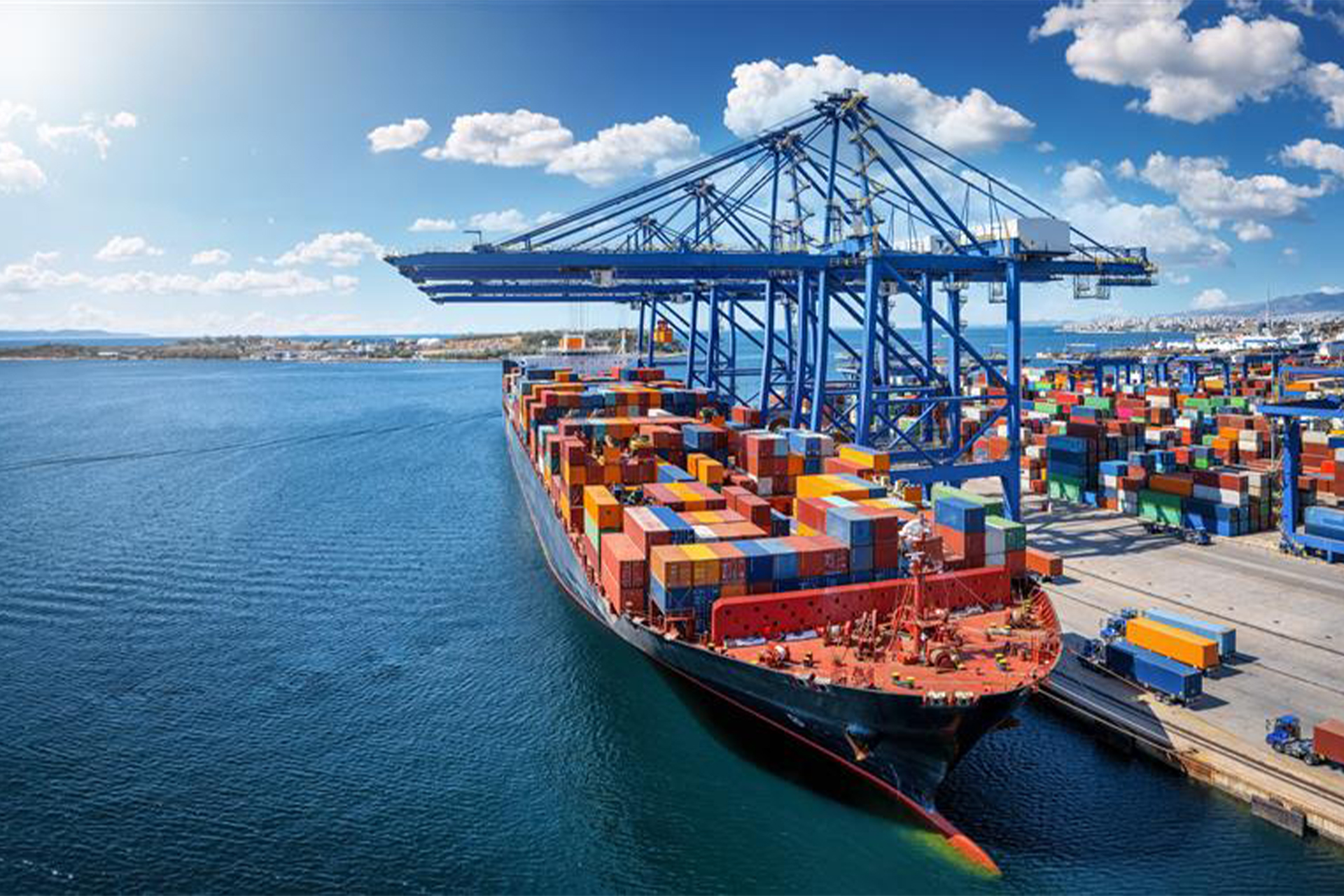
Import volume at major container ports in the United States is likely to decline significantly year over year in the first half of 2026, as the impact of tariffs continues, according to the latest Global Port Tracker report.
Ports have not yet reported their January numbers, but Global Port Tracker projects the month at 2.11 million TEU, up from December and ahead of February Lunar New Year factory closings in Asia, but down 5.2% year over year. Port Tracker forecasts February at 1.97 million TEU, down 3.1% year over year; March at 1.89 million TEU, down 12%; April at 2.05 million TEU, down 7.1%; May at 2.13 million TEU, up 9.3%; and June at 2.12 million TEU, up 8%.
The estimated numbers would bring the first half of 2026 to 12.27 million TEU, down 2% from 12.53 million TEU in 2025. The May and June forecasts show a year-over-year increase largely due to the sharp drop in imports during those months in 2025, following the White House’s announcement of the so-called Liberation Day tariffs in April 2025.
A Supreme Court decision could come soon on the legality of the administration’s use of tariffs under the International Emergency Economic Powers Act, NRF noted. Still, if the court strikes down the IEEPA tariffs, the Trump administration could implement duties under other trade authorities, creating further challenges and uncertainty.
“With tariffs still a matter of debate in the courts and in Congress, their effect on imports is being clearly seen,” NRF vice president for supply chain and customs policy Jonathan Gold said, in announcing the port figures. “The situation underscores the need for clear and predictable trade policies that support supply chain certainty and reliability, business planning and consumer affordability. Tariffs are a tax on U.S. businesses that is ultimately paid by consumers through higher prices.”
Hackett Associates founder Ben Hackett said tariffs have brought “a global change in trade relations” that is affecting import volumes.
“The continuing use of tariffs against friend and foe alike, combined with the uncertainty of when or if they will be implemented, makes trade forecasting very difficult,” Hackett said, adding that last year’s government shutdown is still making up-to-date government data difficult to find. “Following essentially flat container import volumes in 2025 compared with 2024, we expect a decline during the first half of 2026 and likely longer.”
Global Port Tracker provides historical data and forecasts for the U.S. ports of Los Angeles/Long Beach, Oakland, Seattle and Tacoma on the West Coast, New York/New Jersey, Port of Virginia, Charleston, Savannah, Port Everglades, Miami and Jacksonville on the East Coast, and Houston on the Gulf Coast.