

GLP-1 weight management is a major topic of conversation these days across a wide swath of consumer product businesses, including housewares, as use of the medications continues to surge.
By some measures, the effects of fast-growing GLP-1 use have barely been felt in the housewares marketplace. While it may be hard to predict how this major shift in consumer behavior will unfold, retailers and vendors have a significant opportunity to work together to capitalize on this emerging trend.
By some estimates, more than 12.5 million people are taking GLP-1 meds, a number some forecasts project could exceed 30 million.
“It is difficult to change our eating behavior,” said Joe Derochowski, home industry advisor at market research and advisory firm Circana. “However, anytime a doctor gets involved, it opens the door to trying to do something new or different, which creates a new set of needs for the consumer to solve. GLP-1s are doing this and creating growth opportunities for the housewares industry to solve as consumers start to change behaviors.”
Among the opportunities are developing products to meet the emerging needs of GLP-1 users and engaging consumers looking for goods that support their weight-loss efforts.
With the rapid pace of events, partnerships that allow retailers and vendors to respond quickly as trends emerge could prove advantageous, observers said. Partnerships that bring together retailers, housewares suppliers and consumables vendors, such as those producing protein powders and fiber supplements, could also create opportunities for joint merchandising and consumer engagement.
Products to support GLP-1 users are already landing on holiday gift lists. Notable among these requests are blenders that help consumers make beverages to meet changing dietary needs. Moreover, GLP-1s and products that help consumers advance their weight loss should get a big boost from the January resolution season.
“GLP-1 has been a growth driver in 2026 and will continue to be a growth driver for the foreseeable future,” Circana’s Derochowski noted. “The question we need to be thinking about is: How can we help the consumer live this new life? What innovations or inspirations can we do to help solve the new set of needs these consumers will have at this time?”
As doctors initially began prescribing GLP-1 medications for diabetes and weight management, more consumers began to take notice and wonder if GLP-1s might help with less acute weight-related issues. At retail, pharmacy operations saw the first major effects as demand surged enough to make GLP-1s a factor in major retailers’ financial results, with Walmart notable among them.
That impact is beginning to extend beyond pharmacy, with food, supplements, apparel and beauty among the categories seeing early effects. For the housewares sector, those developments could offer an early indication of how changing consumer needs will influence product development and merchandising.
Walmart Sees Opportunity Beyond Pharmacy
Walmart’s financial results demonstrate why pharmacy is central to the retail GLP-1 story. On Walmart’s second-quarter conference call, John David Rainey, the company’s executive vice president and CFO, detailed the substantial effects GLP-1s had on the company as generic versions of some hit the market.
“When looking at the Walmart U.S. total comps, including health and wellness, during each of fiscal year 2025 and fiscal year 2026, we realized 100 basis points of a tailwind from sales of GLP-1 branded drugs,” Rainey said.
The company expects the benefit from GLP-1 sales to moderate in fiscal 2027 as prescription growth is offset by pricing pressures and shifts toward generic medications, Rainey continued.
Walmart is looking beyond the pharmacy transaction. Its combination of pharmacy, food, wellness and general merchandise businesses gives it opportunities to serve consumers as their needs change.
As part of its Wellness Day event this past July, Walmart provided free health screenings, low-cost immunizations and weight-management resources at stores nationwide. The retailer highlighted pharmacist Lore Day, who lost 150 pounds while using GLP-1 medication, to show how its pharmacists can support customers considering or undergoing treatment.
Walmart emphasized that GLP-1 treatment is not just about one prescription, one product or one appointment. Rather, the retailer said, a GLP-1-based program includes broader wellness considerations, including preventive care, weight management, nutrition, fitness, mental health, sleep and even helping consumers find appropriate exercise apparel and support new body dimensions.

Walmart GLP-1 Destination
Walmart has developed a GLP-1 support page that connects nutrition, hydration, recipes and related products with resources such as telehealth and prescription delivery. Its Nutrition Hub includes recipes for consumers adjusting their eating habits while using the medications.
Through Walmart’s Better Care Services platform, consumers can connect with curated third-party providers that offer virtual weight-management support, nutrition guidance, fitness programming and personalized care options. Walmart also has promoted access to eligible GLP-1 prescriptions through the Medicare GLP-1 Bridge Program and announced more than 300 rollbacks on fresh foods and 150 wellness-focused rollbacks on products such as protein bars, powders, vitamins and supplements.
“As customer needs continue to shift, Walmart is focused on meeting customers where they are with relevant, affordable and convenient options across our business,” a Walmart spokesperson said. “Our merchants regularly adapt assortment across categories, from pharmacy and wellness to food, apparel and daily essentials to reflect customer demand, preferences and shopping patterns.”
Pharmacy as the Starting Point for Retail
Pharmacy chains offer another view of how GLP-1s can become an entry point for broader retail engagement. CVS Health, for example, introduced a collaboration with Eli Lilly that connects eligible patients with MinuteClinic weight-management visits, prescription access and pharmacist support. The arrangement shows how pharmacies are building ongoing services around GLP-1 treatment rather than relying solely on dispensing medication.
The pharmacy relationship also creates merchandise opportunities. CVS has expanded its assortment of over-the-counter products and supplements for consumers managing common treatment-related concerns, such as nausea. In select locations, CVS has even mounted dedicated displays bringing those products together. Sponsored by consumer healthcare company Haleon, the displays pair merchandise with pharmacist guidance.
Amazon is pursuing a similar connection between prescription fulfillment and ongoing health services. Its GLP-1 Management Program brings together Amazon Pharmacy and primary or virtual care through Amazon One Medical, positioning weight management as an ongoing relationship rather than a single prescription purchase.

Amazon One Medical
Amazon says One Medical membership is not required to begin its GLP-1 and weight-management program. Its combination of virtual care and prescription delivery illustrates how a retailer can maintain contact with consumers beyond the pharmacy counter.
Tanvi Patel, Amazon Pharmacy vice president and general manager, said of Amazon weight-loss support, “By expanding access to the latest GLP-1 medications with upfront, clear pricing, we’re making it easier for customers to get the treatments their health care providers prescribe and to stay on those medications because they are delivered reliably directly to patients.”
The expansion from pharmacy into grocery makes the broader retail opportunity particularly clear. Supermarket operators such as Kroger are pairing medication access and savings information with nutritional support, protein-rich foods and guidance from dietitians and pharmacists. Those offerings link a prescription-driven consumer relationship to recurring food purchases and potentially to the tools used to prepare meals.
Regional operators are taking related steps. ShopRite, part of the Wakefern Food Corp. cooperative, developed a Wellness Your Way Starter Kit for customers beginning GLP-1 weight-management treatment, with a dietitian-informed aisle-by-aisle shopping guide, product recommendations, recipes and samples. The approach demonstrates how pharmacy-related needs can inform grocery merchandising and meal-planning support.
New Consumer Needs, New Housewares Opportunities
The initiatives at Walmart, CVS, Amazon and supermarket chains suggest that the pharmacy relationship may be only the starting point. Scott Benedict, founder and CEO of consultancy Benedict Enterprises, said the implications of GLP-1 adoption extend far beyond the pharmacy department.
“The way I would think about it is that GLP-1s are creating a new consumer need-state,” Benedict said. “These medications can change how consumers think about food, nutrition, wellness, fitness and even categories such as apparel. For retailers with pharmacy, grocery, general merchandise and digital capabilities, that creates an opportunity to serve the customer much more holistically. We’re already seeing the beginnings of that. Walmart, for example, has expanded its weight-management support beyond prescription fulfillment into virtual care, nutrition guidance and related products. Sam’s Club is also connecting pharmacy with nutrition and wellness support. Kroger Health has emphasized protein, hydration, nutrient density and meal planning as part of its guidance for GLP-1 patients. I would expect that ecosystem to broaden.”
Benedict pointed out that tendencies are becoming clearer in the food and beverage categories GLP-1 users are turning to for weight-loss support.
“Consumers eating smaller quantities may become more focused on what is in those calories: protein, fiber, hydration and nutrient density,” he said. “That could create opportunities for retailers and companies to rethink assortment, package sizes, portioning and even how products are merchandised and discovered. The opportunity isn’t necessarily to slap GLP-1 on a package. In fact, I would be cautious about doing that. It is to understand how the customer’s needs are changing and develop products and solutions around those needs.”
“Consumers eating smaller quantities may become more focused on what is in those calories: protein, fiber, hydration and nutrient density. That could create opportunities for retailers and companies to rethink assortment, package sizes, portioning and even how products are merchandised and discovered.”
– Scott Benedict, Founder & CEO of consultancy Benedict Enterprises
As more consumers adopt GLP-1 medications, retailers and suppliers may find opportunities across a broader range of products, from hydration and fitness to food storage and portion management.
“Hydration products, supplements, fitness products and food storage or portion management solutions are reasonable adjacencies,” Benedict said. “Apparel is particularly interesting because significant weight loss can create a very practical wardrobe-replacement occasion. There may eventually be opportunities in beauty and personal care as well. I would expect innovative suppliers to increasingly examine these changing consumer needs when developing products and working with retailers.”
Beyond product opportunities arising from GLP-1 use, addressing the needs of those on the medications can expedite relationship building.
“A retailer that can connect prescription fulfillment, pharmacist interaction, nutrition guidance, relevant merchandise, digital content, delivery and loyalty has the opportunity to create an ongoing relationship with that consumer,” Benedict said. “Instead of thinking about a GLP-1 prescription as a pharmacy transaction, think about weight management as a customer journey that might last years.”
Even as retailers and vendors work to understand the ramifications of GLP-1 adoption, consumers are weighing whether and how weight-loss medications are affecting other purchase behaviors. AlixPartners, in a study on apparel, cautioned that GLP-1 users aren’t running out to purchase new wardrobes. Right now, at least, consumers are spending more money on alterations even as demand for larger sizes is softening, the study indicated.
Where Housewares Fits
Circana’s Derochowski pointed to growing demand for protein as one example of how changing dietary needs could create opportunities for housewares.
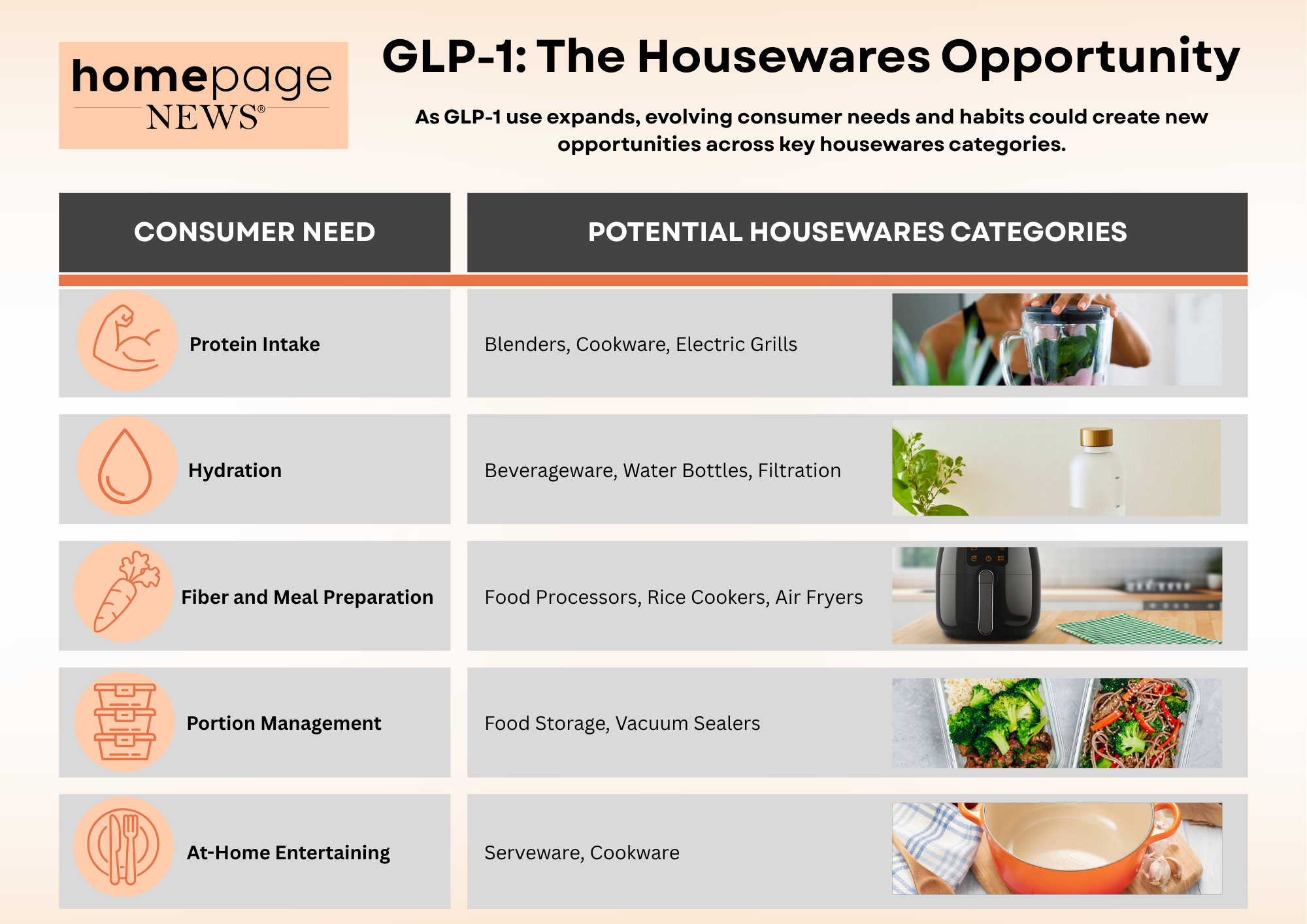
“Consumers will be at risk of losing muscle mass, so they will want more protein,” he observed. “This is good for cookware to help make eggs with breakfast or open the door for single-serve or traditional blenders to make smoothies boosted with protein. Air fryers and electric grills will help with cooking protein at dinner. Vacuum sealers will benefit from people buying more protein.
“So, while each meal occasion will provide opportunities for the traditional means of making protein, the white space opportunities will be for those items to help make solutions for in-between meal protein opportunities, like baking a frittata and storing for these occasions to be warmed up,” Derochowski continued. “Finally, consumers will try to lift weights more, opening the door for portable beverageware.”
Hydration is also an issue for GLP-1 users as it helps address digestive issues. “Consumers will look for ways to get more water to help with constipation, so beverageware, portable beverageware and water filtration devices have an opportunity to help consumers,” Derochowski said.
Consumers will also look to consume more fiber to support proper digestion. “So, products like rice cookers to be used to make oatmeal, food processors and choppers to help prepare vegetables,” Derochowski added. “Cookware and air fryers to heat the vegetables. There will be many opportunities for housewares to help consumers add fiber to the various meal occasions.”
As GLP-1 use begins affecting more product categories, the medications’ influence on the retail purchase path could be more significant than it may seem at first.
Because GLP-1s affect personal behaviors such as dining for what can be months, those on the medications are likely to change routines not only immediately but also in the longer term. Behavioral changes won’t be isolated, as adaptations made by GLP-1 users will affect anyone living with them. In that way, GLP-1 is akin to a lifestyle change, one that might be temporary or might not.
Beyond changes in diet and meal preparation, Derochowski sees potential for GLP-1 use to influence how consumers socialize and entertain at home.
“They will entertain more,” Derochowski said. “After being on GLP-1s for a few months, consumers become more social. They start… entertaining at home more. This presents an opportunity for serving dishes, food storage and items needed to make the food and beverages for these entertaining moments. What can we do to help these moments be memorable?”
As GLP-1 users get deeper into their weight-loss efforts — and as the meds make lower food intake easier to endure — they may be more likely to prep appropriate foods at home, air-fry kale chips or cook protein- and fiber-rich soups, bringing kitchen electrics and cookware into play. Some consumers could embrace portable appliances, such as personal blenders, to make fresh GLP-1-friendly foods and drinks on the go, especially given the return-to-office surge.
Retailers could also explore cross-merchandising opportunities, such as displaying portable blenders alongside protein powders or positioning air fryers near fresh seafood and meat with meal suggestions emphasizing protein-rich preparation.
Reaching the GLP-1 Consumer
Product development is only part of the opportunity. Retailers and suppliers also need to consider how to reach GLP-1 users as their dietary habits, shopping behaviors and lifestyles change.
Dr. Mohamed Amer, adjunct professor and CEO and founder of BridgeCommAI, said retailers and vendors should consider social media and influencers when planning their communications. Because GLP-1 use can bring changes in digestion and diet, consumers may start looking for peer-to-peer support as they begin therapy. Social media and outreach to and through influencers can give companies developing GLP-1-related products and services an edge. In addition to connection, social media and influencers can give retailers and vendors insight into keywords and cues emerging among people on the medication.
Amer said retailers and vendors might want to take a lifestyle perspective regarding the medications because treatment can stretch for months, sometimes years. Beyond direct effects, GLP-1s train people to eat smaller portions, as overconsumption creates discomfort, which may change eating patterns for individual users and their families.
“Your appetite has been recalibrated,” Amer said. “It’s been adjusted, and that means you have new behavior but within the same family and familial patterns.”
As such, family members might not all be eating the same food at the same time, complicating meal preparation. Or they may all eat smaller portions and have similar needs for protein and fiber supplementation. Changes in how GLP-1 users approach food could cross over and become more typical of the people they influence. Then, smaller portions may encourage consumers to eat meals richer in flavor to make up for less intake. The same influences might also push consumers to upgrade cookware so they can enjoy more satisfying meals despite smaller portions.
Beyond any one segment, GLP-1 use can have multifaceted effects because it changes family and social perspectives.
“Major body transformation triggers changes in your life that transcend into broader home refreshes,” Amer said. “Major lifestyle changes, whether it’s a divorce or relocations or a significant weight change, drive home category spending.”
“Major body transformation triggers changes in your life that transcend into broader home refreshes. Major lifestyle changes, whether it’s a divorce or relocations or a significant weight change, drive home category spending.”
– Dr. Mohamed Amer, Adjunct Professor & CEO, BridgeCommAI
GLP-1 use is, Amer added, “just going to accelerate, and the shift that happens is a structural shift. We’re at the front end of what’s going to be. Retailers should treat this as a five- to 10-year structural reshaping of consumer identity, and they need to position for that. From a vendor perspective, they need to look at two different fronts: the product development for the GLP-1 user profile, and around the data infrastructure that you need to get those products accurately onto the digital shelf, not just the physical shelf, but the digital shelf.”
BridgeCommAI assists companies in putting products or expanding their presence on shelves, physical and digital. Right now, Amer said, an important opportunity for vendors and retailers is to develop systems that track and analyze GLP-1 consumer behavior as they create products and services, then target them appropriately over time.
Amer also emphasized the importance of data as retailers and suppliers look to identify emerging consumer needs and improve product discovery, including through AI-powered shopping tools. He pointed to receipts, direct-to-consumer sales, Amazon sales velocity and household penetration as evidence suppliers can use when pitching products and partnerships.
Neil Saunders, managing director, retail, at GlobalData, an analytics and consulting firm, said even as companies become increasingly aware of the impact GLP-1 can have on their operations, the effects will vary by degree and over time.
“In non-food sectors, the disruption might be more gradual than dramatic, but retailers do need to prepare,” Saunders said. “There are simple things, like sizing profiles in fashion. And there are more nuanced things, like beauty habits and routines changing and the style of apparel people buy changing once they lose weight.”
Even as GLP-1 medications gain traction, their effects are not being felt evenly across categories.
“GLP-1 use will likely expand strongly over the next five or so years,” Saunders said. “The drugs are becoming more accessible and easier to use and that is helping to drive uptake. There are also many health benefits from losing weight, as well as aesthetic considerations, which drive demand. The only thing that could potentially derail the rise is if some bad side effect was found. The drugs are still early in their lifecycle, so we don’t fully understand the longer-term impacts.”
As GLP-1 adoption evolves, Saunders said retailers and suppliers will need to monitor demand changes and consider how long-term weight management could affect purchasing patterns.
“Ultimately, I think GLP-1s provide retailers with an interesting test of what omnichannel really means,” Benedict said. “Retailers have spent years connecting stores, digital commerce, loyalty, pharmacy and services. Weight management is exactly the kind of complex customer journey where those capabilities can work together. The retailers that approach this simply as a pharmaceutical sales opportunity may capture the prescription. Those that approach it as a broader health-and-wellness journey have an opportunity to build a much deeper and potentially longer-lasting customer relationship.”

