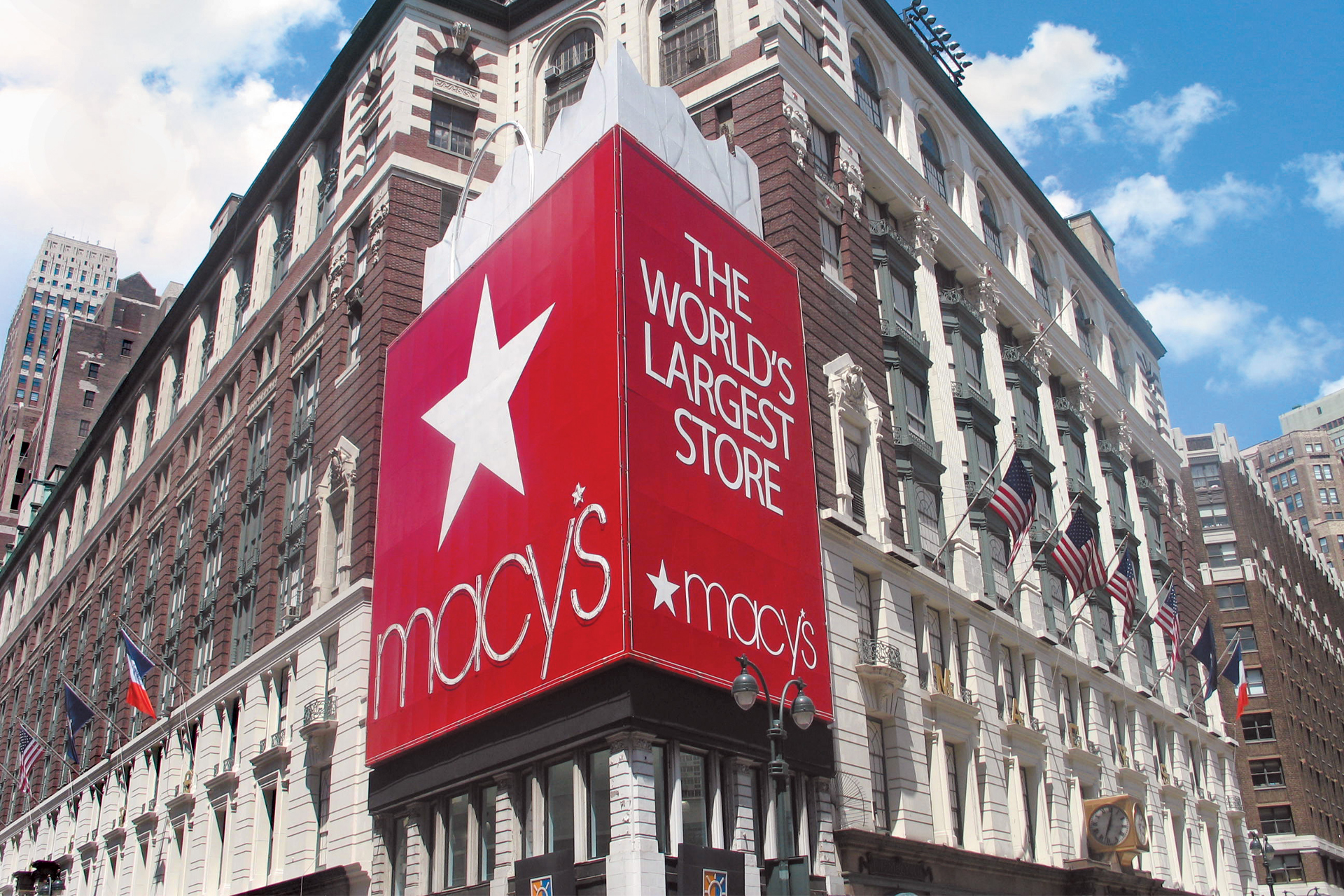
Beating Wall Street forecasts, Macy’s delivered second-quarter results marked by positive comparable sales and raised its full-year guidance.
Net income was $87 million, or 31 cents per diluted share, versus $150 million, or 53 cents per diluted share, in the year-previous quarter. Adjusted for one-time events, net income was $113 million, or 41 cents per diluted share, versus $149 million, or 53 cents per diluted share, in the period a year before.
An analyst consensus estimate from Zacks Investment Research called for earnings per adjusted diluted share of 19 cents and revenues of $4.72 billion.
Macy’s reported a comparable sales increase of 0.8% on an owned-store basis and 1.9% on an owned-plus-licensed-plus-marketplace basis as comps gained across banners.
Net sales were $4.81 billion and total revenue was $5 billion versus $4.94 billion and $5.1 billion in the year-earlier quarter, the company noted. Operating income was $149 million versus $222 million in the year-prior period.
Macy’s banner comps gained 0.4% on an owned basis and 1.2% on an owned-plus-licensed-plus-marketplace basis, the company maintained. Macy’s go-forward stores, which are not part of store closure plans, saw comps advance 0.7% on an owned basis and 1.5% on an owned-plus-licensed-plus-marketplace basis. Bloomingdale’s comps were up 3.6% on an owned basis and up 5.7% an owned-plus-licensed-plus-marketplace basis, while Bluemercury comps were up 1.2%.
Macy’s pointed out that its 125 upgraded locations, dubbed Macy’s Reimagine, enjoyed comp growth of 1.1% on an owned basis and 1.4% on an owned-plus-licensed basis.
Macy’s raised its guidance for net sales, now $21.15 billion to $21.45 billion from $21 billion to $21.4 billion, owned-plus-licensed-plus-marketplace comps, now down 1.5% to down 0.5% year over year from down 2% to down 0.5% year over year, and adjusted diluted earnings per share, now $1.70 to $2.05 from $1.60 to $2.
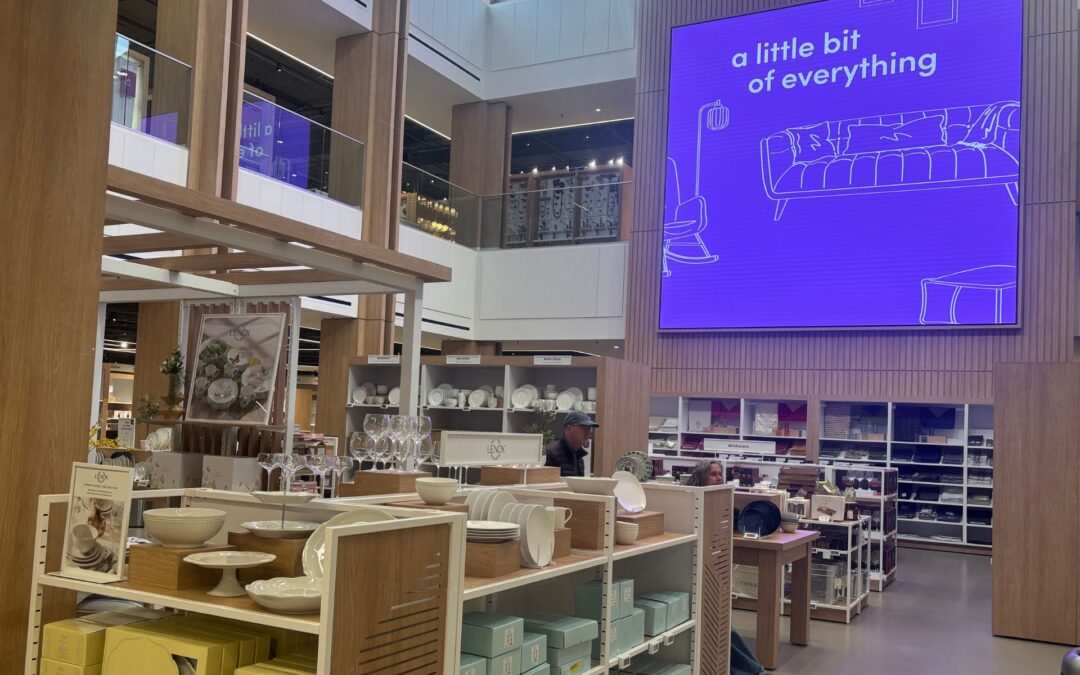
As part of a conference call, Tony Spring, Macy’s chairman and CEO, identified home furnishings as one product segment that helped drive sales growth in the quarter. The company’s Backstage off-price and marketplace operations were also significant contributors to sales growth.
Springs added that Macy’s demonstrated resilience across banners through the first half of the current fiscal year, but given the uncertainty regarding the impact of tariffs on demand, the company concludes that it’s sensible to continue to think in terms of consumers remaining prudent in their purchasing for the rest of 2025. As such, the company’s full-year guidance incorporates a 40 to 60 basis point tariff impact to gross margin, up from an earlier expectation of 20 to 40 basis points, equating to 25 to 40 cents of earnings per share versus 10 to 25 cents formerly.
He pointed out that Macy’s is adjusting prices on an as-needed basis as it works with vendors and internally to mitigate tariff effects.
In announcing the financial results, Springs said, “Our teams achieved better than expected top- and bottom-line results during the second quarter, driven by our strongest comparable sales growth in 12 quarters, reflecting the strong performance in Macy’s Reimagine 125 locations, Bloomingdale’s and Bluemercury. Our performance highlights the advantages of being a multi-brand, multi-category, omni-channel retailer. The substantive, enterprise-wide improvements across our business, with a strong focus on customer experience, give us further confidence that our Bold New Chapter initiatives can drive sustainable, long-term profitable growth.”